
Archive
The Benefits of Promotional Products at Trade Shows
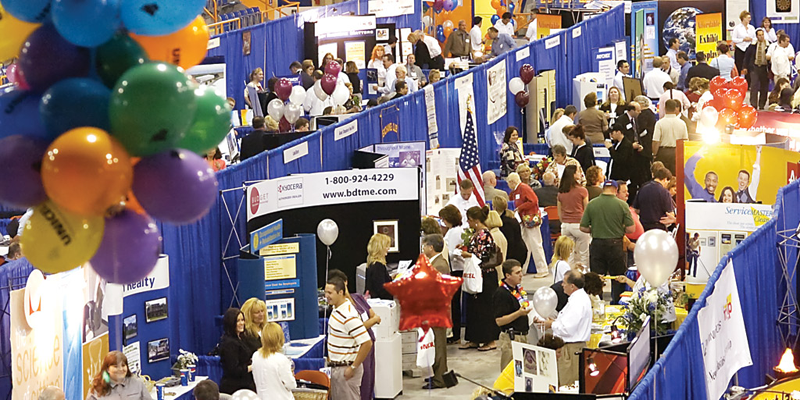
Promotional Products for Exhibitors
If you’re an invested business owner, then you are constantly looking for every edge possible to help differentiate your products and services from the competition.
Well, trade show management companies are no different. With you folks in mind, we’ve developed some creative ideas for helping exhibitors to enhance their bottom line and show some personality – and some SWAG, too.
Ready for that? Good. The first idea is to develop unique, never-been-seen-before event materials and the second is giveaways, for both the show and its exhibitors.
The benefits of this approach are two-fold:
1. A show is the perfect opportunity for companies to use their own promotional products to add a sense of personality to their brand, promote a memorable theme, and stand out in a sea of boring, SWAG-less cookie-cutter conferences.
2. By offering exhibitors marketing services around the design and execution of unique SWAG, a show can earn a portion of the merchandise revenue while increasing exhibitors’ happiness and retention. It’s win-win to the max.
What’s the alternative? Well, you’ve seen it before. Merely slapping logos on pens and coffee mugs is not enough. And it sucks. To execute on this approach and do it well, most show management companies need to engage with a strategic promotional products company with vast creative experience and the ability to draw on a large network of suppliers.
This partner should act as a marketing agency that places an emphasis on using physical products to promote the message.
And guess what? Often times, that creative promotional products company can employ physical products as a gateway to the virtual world with something like augmented reality technology. In doing so, they take this idea of differentiating the trade show itself while also helping exhibitors stand out to another level.
The best part? Augmented reality is easier to deploy to an entire trade show than you might think. There is a branded augmented reality app available that integrates the technology into a company’s preexisting app. This sets the stage for promoting and gamifying the show in fun new ways, meaning that you’ll keep someone’s attention long after they’ve left your booth and moved on.
It also presents another opportunity for the show to help exhibitors by leveraging the same technology platform to integrate digital content with their promotional products, literally duplicating the efforts of something that does quite well on its own, and even better with the SWAG of augmented reality.
A Great Promotional Product
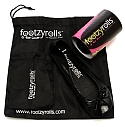
 Footzyrolls is an exciting new product that has recently been introduced into the market. They were created by two sisters – Jennifer and Sarah Caplan. These rollable shoes are becoming quite popular as they’ve reportedly been worn by famous stars, such as Kim Kardashian and Blake Lively. They are quickly gaining a lot of attention because of their unique comfort and style.
It is easy to see why Footzyrolls are great to giveaway as advertising merchandise for your company. You’re not only giving a wonderful gift to your receivers that will solve a very common problem, but you’re also promoting your company. Each time they wear their exciting new Footzyrolls, they’ll be reminded of your business in a positive light. When they have a need or problem, they will likely think of your business first for a solution. Footzyrolls can really get you and your business stepping in the right direction!
I have a link for the online retail store on this blog. If you are looking for branding opportunities for your company. Please contact me directly via our Fan page or my email.
Beyonce launches a line of Temporary Tattoos

I know what you’re thinking… Beyonce is creating her own line of temporary tattoos? She did and they are very popular.
Starting November 1st, Beyoncé and Japanese makeup brand Temptu have partnered with Deréon to create a range of temporary tattoos. Some of the available temporary tattoo designs will include Deréon’s signature fleur icon, spiders, bolts and chains and jeweled baubles designs, to mimic the theme and feel of the overall fall collection.
The tattoos will be available in two different packages including a basic and a deluxe edition. Both options will consist of eight temporary tattoo transfer sheets (2 sheets each of the 4 designs); 10 tattoo application pads and one of three kit designs, each featuring a different fall and winter Deréon ad campaign image of Beyoncé, all for $16. However, if you opt to spend the asking price of $34, the deluxe edition will also include a signed photo of Beyoncé and a chance to win a trip to New York for a photo shoot.
The temporary tattoo technology has improved greatly; and in either choice, all of the tattoos are waterproof and designed to last for two to five days. They come in a variety of design and sizes, as small as coin to as large as the full body design on the right
They are slated for a retail arrival in November and will be available at Sephora stores in the U.S. and Canada, Sephora Online, and at both Deréon and Temptu’s websites.
If you want to learn more about temporary tattoos, please feel free to contact us and request samples via our Fan Page.
A Worldwide Phenomenon
Wondering what that is those kids are wearing around their wrists?
We’ve turned this worldwide phenomenon into the hottest value-priced promotional product on the market! Kids of all ages love to wear’em and trade’em!
Our Squiggles are available in seven themes and come packaged in a random assortment of 6 rubber bands in a polypack with a full-color advertiser card. (Note: You cannot specify the assortment but, don’t worry, everyone will love them anyway!)
Available themes:
Dinosaurs Sea creatures Insects Fruit
Music Transportation Dental Animals
Need custom shapes? Just ask for a quote!

T-Shirt Buyers BEWARE! The Cost of Cotton Through The Roof.

I was reading blogs, posts and other information when I ran across this from ASICentral. The numbers are alarming, so if you are in the business of T-shirts, please take note! Prices will have doubled from last year by Fall of this year.
This isn’t a sales tactic or some sort of guerrilla marketing campaign. These are the facts!
Cotton Costs Increase Rapidly
According to the National Council of Cotton, world cotton prices are now about 50% more than last year at this time – from about 60 cents per pound to 90 cents per pound – and will likely increase further in the coming months. With T-shirts the top-selling item in the ad specialty industry, suppliers, already feeling the pressure of the increase, are advising distributors to prepare for costs on apparel to climb in the next few months.
“By late summer and early fall distributors will start to see across-the-board price increases,” says Anthony Corsano, CEO and president of Anvil Knitwear (asi/36350), though he could not say exactly how much costs would increase by. Corsano suggests that distributors order supplies for orders as soon as they can to lock in lower prices where possible.
Gary Adams, vice president of economics and policy analysis for the National Council of Cotton, agrees, saying that distributors, “have to anticipate what their needs are going to be as much as possible so they’re not caught short or unaware.” Adams says that not only has the price gone up, but as corn and soybeans have become more profitable crops to produce, and regions like India have curbed their exports, the supply of available cotton has gone down. “We are seeing those higher prices moving up the textile processing chain – yarn prices are higher than they were a year ago, and eventually that’s going to make its way up to the retail level.”
Echoing this sentiment, Garry Hurvitz, president and CEO of Counselor Top 40 supplier Ash City (asi/37127), recently sent a letter to customers outlining the current apparel pricing environment and specifically pinpointing cotton as a raw material cost that was increasing. In the letter, Hurvitz wrote, “Specifically impacting our cotton based apparel is the worldwide shortage of this product and with yarns being more difficult to obtain, we are seeing production delays and material cost increases everywhere.”
Add to: Facebook | Digg | Del.icio.us | Stumbleupon | Reddit | Blinklist | Twitter | Technorati | Yahoo Buzz | Newsvine
Why use Promotional Products and Solutions?
Your investment in Promotional Solutions provides more return than [tweetmeme source=”javilabbe” https://javilabbe.wordpress.com%5Dmost media. Of course, when putting a promotional solution in place, it is always best to add measurement to determine ROI. Wouldn’t it be nice to see what kind of return you get on average from various promotional products?
Thank you ASI for the Research.


If you’re looking for a partner for all of your promotional, printing eCommerce and multimedia needs, we’d love to hear from you.


Promotional Marketing | The History
Early History Of The Promotional Products Industry
[tweetmeme source=”javilabbe” https://javilabbe.wordpress.com%5D
The first known promotional products in the United States are commemorative buttons, tracing back to 1789, when George Washington was elected president. Dating back to the early and mid 1800s are advertising calendars, wooden specialties and the Farmers’ Almanac. But it was not until the latter part of the 19th century that an abundance of promotional products were developed and marketed, leading to the birth of the industry as it is known today.

Jasper Freemont Meek was one of the earliest significant contributors to this budding industry. He owned a small newspaper in Coshocton, Ohio, and like many other small newspaper owners of the time, he supplemented his revenue by taking on job printing, which used his printing press between editions.
Seeing a child drop her schoolbooks in the dirt on Main Street spurred Meek to approach his friend, Mr. Cantwell, owner of Cantwell Shoes, with an idea about building store traffic, name recognition and ultimately increasing sales.
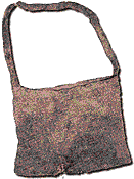
Meek’s idea was to imprint a burlap book bag with a simple but direct advertising message, “Buy Cantwell Shoes.” Cantwell would give every child who came into his shoe store a free bag. The children would carry the bag as they walked to and from school so Cantwell’s name would be seen all over town. Mr. Meek manufactured the book bag, imprinted the advertising slogan on his printing press, and both Meek and Cantwell reaped the rewards.
After launching another successful promotional product—imprinted horse covers, seen on virtually every horse in town—Meek officially started his own innovative and successful promotional products company, the Tuscarora Advertising Co. He organized a sales force, who until 1889, would sell specialty items with practically no competition.
Ironically, Meek’s first competitor was Henry D. Beach, another small newspaper man in Coshocton, Ohio. Both men were aggressive and wanted to be the first to create new products by printing advertisements on anything that could be run through a printing press: cloth caps, aprons, hats for horses, bags for marbles, buggy whips, card cases, calendars and fans.
Beach was the first to take an interest in printing metal signs, and soon Meek became interested in the process as well. Both were aware that perfecting a printing process for metal would open up an entire new product line. Both succeeded, and although Beach managed the process first, both were successful, and proceeded to produce metal advertising trays (Coca-Cola®and some beer companies are the best known), which are collectors’ items today.
Two more newspaper owners, Thomas D. Murphy and Edward Burke Osborne, of Red Oak, Iowa, are credited with the birth of the art calendar in the late 1800s. Like Meek and Beach, they needed a business to keep their presses going and to bring in additional revenue. Osborne had an idea to print a watercolor painting of the new Red Oak courthouse on cardboard, place advertising around the painting, and then, attach a calendar pad. The calendar was an instant success, and even today, no home or office is without one.
Selling advertising space on calendars was not new, but until Murphy and Osborne, no one had thought of placing attractive art on the calendars. The men purchased photographs and paintings from a variety of artists. They also improved printing capabilities so that three-color images of original paintings could be printed. By 1894 Murphy and Osborne employed 94 people, including 14 traveling salesmen, and produced between two and three million calendars.
At the end of that same year Murphy and Osborne ended their partnership. Murphy sold his interest in the business to Osborne. Osborne went on to expand the business. In order to be closer to art and business centers, he moved the company to Newark, N. J., then established a pricing schedule and acquired a new printing process, now known as letter-press printing. Osborne later expanded his highly successful calendar business worldwide, setting up plants in Toronto, London and Sydney, Australia.
By the way …
Have you ever wondered how the pocket protector got its start? It was a promotional product designed to sell slip-on vinyl covers that protected loose-leaf binders.
via ppai.org
Foundog Acquired by Google-Backed Life360
Combined company offers extended suite of next-gen promotional products:
As one of the largest promotional products distributors in North America we offer countless brandable consumer saftey minded products. I think this is something you will find very interesting.
SAN FRANCISCO – March 11, 2010 – Life360, the all-inclusive online service for managing family safety and security, announced the acquisition of Foundog, the DFJ-backed lost item recovery service. The acquisition provides a powerful set of next-generation promotional products to corporate customers.
Life360 board member and former CEO of Visa USA, John Philip Coghlan, remarked, “With the addition of Foundog’s recovery solutions and corporate promotions channel, Life360 is able to offer unparalleled brand awareness and return-on-investment to corporate marketers with a suite of products that integrates into the daily lives of consumers.”
All recipients of Foundog’s brandable global item recovery tags will gain free access to a white labeled version of Life360’s online safety and security suite, which includes services that provide identity theft protection, cell phone-based family tracking, emergency child identification, lost item recovery, sex offender monitoring, and an emergency messaging system to reconnect families even when some communication lines are down after a natural disaster. Every time an end user logs into the Life360 suite, they will be exposed to the sponsor’s brand.
“Our corporate clients such as IBM, Symantec and HSBC will now benefit from extended touch-points in their marketing campaigns using Life360’s suite of promotional products,” said Foundog Chairman Geoffrey Nudd. “A Life360 campaign generates customer loyalty over a multi-year period with a broad safety and security value proposition.”
Life360 CEO Chris Hulls commented, “In this tough economy, corporate marketers are looking for promotions that provide a clearly measurable value. Through the integration of the Foundog and Life360 offerings, ASI, SAGE, PPAI and other distributors can offer corporate customers a suite that generates immediate returns through brand awareness, the ability to obtain sales leads and actionable market data from recipients.”
For more information, please visit: www.life360.com

About Life360
Life360, a Google and Facebook-backed technology company, offers consumers a way to manage their full range of safety and security needs all in one place. Services range from identity theft protection, to lost item recovery, medical identification, and family tracking. Founded in the aftermath of Hurricane Katrina, Life360’s mission is to use emerging technology to help people prepare for both major emergencies and everyday worries. For more information, please visit www.life360.com.
About Foundog
Foundog is an ASI, SAGE, and PPAI supplier of next generation promotional products. Foundog’s flagship product line, the eTriever Tag and Global Recovery Service, is used by many of the world’s largest high tech companies, law firms, financial services providers, hotels, transportation companies, insurers and others. Foundog’s team of software developers, manufacturers and marketers works with distributors to provide customized marketing solutions for corporate clients. For more information, please visit www.foundog.com.
Looking Beyond ROI with Promotinal Products
 Construction Industry
Money is short and the years of frivolous spending are over. We are no longer living in a time when companies will throw money at a marketing campaign without looking for results. Companies have been forced to be smart and are now being held accountable for their efforts.
The most popular term that marketers use to measure results is ROI (return on investment), which evaluates the effectiveness of an investment. Most often it is simply referred to as the return or benefit. However, a new buzzword has arisen in marketing circles. Beyond ROI, marketers are increasingly using ROO (return on objective) as a measuring tool. A bit more simplistic and straightforward, ROO measures the achievement of set goals. Simply: “A client wants that.”
This is where you come in. Promotional products, if used correctly, can deliver the level of measurement that marketers are looking for. Because of their ability to appeal to all five senses and their adaptability to any industry, promotional products are the ideal solution to any marketing dilemma.
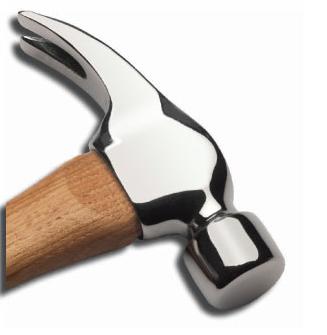
For example, the construction industry is complex and ever changing, as the demands are great and the challenges are many. Builders are finding it more difficult than ever to maintain a strong labor force, while securing raw materials.
The construction marketplace is divided into three sectors:
- New home construction and residential improvements
- Commercial
- Heavy engineering/non-building/tool manufacturers
In order to market to this group most effectively, you must do a few things:
- Show the cost relevance of your products and services, particularly how the value of both will positively effect your client
- Show measurement of the existing marketing efforts
- Deliver more than just products and services-deliver solutions
Those solutions must have a strategy:
- Uncover the need or exact pain point
- Drill down to a specific audience
- Create a theme
- Determine the winning success matrix
- Unleash your creativity, making sure it fits the need and satisfies client objectives
Remember the ROO. Work with your clients to set realistic goals. Then deliver. It’s this simple. Whether in the construction industry or any other industry, clients want an edge that sets them apart from the masses. Look at the challenges they face and how your efforts can solve them.
Remember: You offer more than just products—you offer solutions. Promotional products are an essential element in the marketing mix. Adding your message to a tangible product turns an ordinary message into a marketing experience your audience can see, touch, hear, smell and even taste. Promotional products are the only way to make a sensible—and memorable—impression.
For more information about Proforma PPG or to learn more about the proven power of promotional products (including research, products and services), visit the Proforma PPG website or contact Proforma PPG at 847-429-9349, kathy.labbe@proforma.com.
Promotional products are an $18.8 billion industry and include wearables, writing instruments, calendars, drinkware and many other items, usually imprinted with a company’s name, logo or message.
Why Use Promotional Products?
Here are a few case studies
Nintendo of America
 Objective: To assist Nintendo of America with the post-launch marketing and branding of the new Wii game system.
Strategy & Execution: The most unique aspect of the new Wii game system is the hand-held remote that allows players to interact wirelessly with the game screen. Capitalizing on this point of differentiation among its competitors, Nintendo designed a key chain flashlight replica of the remote. Even better, the lighted element of the keychain was a blue light, similar to the blue LED light on the real remote. The keychain was promoted on Nintendo websites as a free gift for new subscribers of Nintendo Power Magazine. The “gotta have it” appeal of the keychain quickly made it a hot topic on Nintendo blogs and on gaming bulletin boards. The keychain may even earn a “bonus life” as there has been significant interest from retail stores to offer the item for re-sale.
Results: Immediately following the promotion, there was a distinct and significant spike in subscriptions to Nintendo Power Magazine. To date, more than 130,000 Wii Lighted Remote Keychains have shipped with even more purchase orders submitted.
Arby’s, RTM
 Objective: To create a long term “coupon” that a customer would keep and re-use often, due to its convenience and ease of use.
Strategy & Execution: Every fast-food chain distributes paper coupons in the mail or as Sunday paper inserts. But how many of those coupons are actually in the car when the consumer is ready to make a purchase? The Arby’s Discount Key Card offers a permanent discount to anyone holding the card, and, as a key tag, it’s always with the diner. Better still, every time the diner takes their keys out of their pocket, they’re always, “Thinking Arby’s.” This is a no limit, non-expiring coupon that has actually increased the average ticket by twenty cents. Initially targeting college students in the Fort Wayne, Indiana, area, the card became an enormous success and is being strongly considered for roll-out as a nation-wide item. Arby’s is the first in its industry to offer a loyalty key tag program; apparently, “Thinking Arby’s” means “thinking smart!”
Results: One store in the target area reported a 25% sales increase due to use of the card. Another store reports that 25% of its guests are card users. With this brilliant, but simple idea, Arby’s has broken through the “coupon clutter.”
Aqua Condominiums
 Objective: To boost and sustain owner excitement and commitment during the two-year construction phase of a beachfront resort condominium project.
Strategy & Execution: During the construction of the Aqua Condominium Resort, extreme hurricane activity in the area threatened to discourage owners who had signed pre-construction contracts. To keep enthusiasm high among potential owners, developers employed an ongoing promotional product campaign to build brand awareness and loyalty. A collection of premium gifts was selected and branded with the Aqua logo. Throughout the two years of construction, owners regularly received luxury beach towels, tote bags, cheese sets, chef’s aprons, bath robes and other items, all designed to paint a picture of what the relaxing, carefree lifestyle would be like, once the condominiums were complete. The campaign was supported by quarterly newsletters, personal letters from the developer and “road show” owner parties in various cities where pockets of owners lived…truly a multi-faceted, cohesive marketing campaign. The final touch was an acrylic Aqua logoed wine bucket and a bottle of wine welcoming owners to their new condominium.
Results: Upon completion of the property, every pre-construction contract converted to a closed unit. Furthermore, due to heightened brand awareness and buzz, the 212 units condominium tower can boast
100-percent closed status.
Ciba Specialty Chemicals
 Objective: To increase industrial safety awareness and to improve overall safety performance.
Strategy & Execution: With the creation of the “Road 2 Zero” campaign, Ciba Specialty Chemical challenged its plant managers to reach one million man-hours worked with zero hours lost time due to on-the-job injury. The “Road 2 Zero” brand was posted throughout the plant on kiosks and billboards and with special banners and flags. At a kick-off fish-fry, each employee received a “Road 2 Zero” baseball cap with a tire tread bill. A safety task force comprised of the different department managers held a series of safety seminars with each task force member wearing a bright read, “Road 2 Zero” t-shirt. Employees attending the seminars were rewarded with a variety of promotional items…items that increased in value depending on the type of seminar and the number of seminars attended. Carabiner flashlights, soft-sided lunch coolers and multi-function tools led to high attendance numbers. In addition, Safety Task Force leaders were awarded premium items such as laser engraved fleece jackets based on the attendance of employees from their product line. When the plant announced, on the one-year anniversary of the program and the achievement of the “zero” goal, every employee received a 13-quart Rubbermaid Cooler…presented at a celebratory steak dinner!
Results: Not only did the plant achieve its primary “zero lost hours” goal, Ciba has enjoyed residual decreased injuries due to heightened safety awareness. On-site accidents have dropped 59 percent since the launch of the program.
Essex Insurance Company
 Objective: To launch a memorable continuity program that would introduce the company’s management team and help kick off the 25th anniversary year.
Strategy & Execution: Essex Insurance Company enjoys a unique relationship with its agents in the field, one built on mutual respect and on the ability to keep things lively and fun. That culture made this delightfully creative campaign possible. Throughout 2005, agents received bobblehead characters depicting the Essex management team. he campaign continued with a contest that asked the question, “Where in the world have your bobbleheads been lately?” Agents submitted photographs of the bobbleheads posed in various locations and situations. The contest culminated in a full-color, custom calendar for 2006 showcasing the twelve best photographs. Finally, in December 2006, agents received a custom deck of playing cards featuring the thirteen management team bobblehead characters.
Results: The campaign has generated considerable familiarity and unity between the management team and the agent base. Virtually every agent now recognizes members of the management team on sight, creating invaluable corporate camaraderie.
American Marketing Association
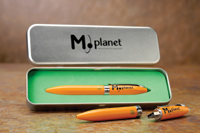 Objective: To generate interest in the American Marketing Association and to increase membership by reflecting a high degree of industry expertise and credibility.
Strategy & Execution: Using a marketing program to connect with savvy, senior-level marketing professionals is a daunting task. This is an audience not easily won over by average campaigns or unoriginal ideas. Still, the AMA rose to the challenge, opting to keep it traditional by designing a pen, but adding a modern twist to this classic promotional item. Presented at the 2006 “M.planet” industry conference, the handsome, vivid orange pen doubled as a USB flash drive. The drive came pre-loaded with all conference materials: PowerPoint presentations, articles, speaker support, literature and seminar materials. The large capacity of the drives still allowed for plenty of personal storage space. One end of the pen could also be used as a stylus for PDAs, making this “old school” item a thoroughly modern device for the electronic age. Of course, presentation is everything, and the AMA made sure the pen was delivered in a dramatic, black and silver alloy case–totally cool and stylish.
Results: The pens were an immediate hit, but when conference attendees realized they’d be taking home all of the conference materials and presentations on the pen’s flash drive, the buzz surrounding the pens spread even more quickly. AMA continues to get calls from marketing professionals asking about the pen.

New Footzyrolls, the rollable shoe



 Get Connected